
The Origins of a Global Scientific Mobilization
This initiative took root in October 2023 following a request from the President of the French Republic, Emmanuel Macron. The objective was to synthesize scientific evidence regarding the severe risks associated with authorizing the exploitation of the deep sea.

An International Scientific Proclamation
Under the direction of Françoise Gaill (CNRS) and Bruno David (MNHN), a committee of seventeen international experts was formed to represent a diversity of backgrounds and expertise. Coordinated by the Towards IPOS program, this transdisciplinary work successfully bridged the gap between science and public action by proposing concrete and credible recommendations.
The press conference on March 31, 2025, formalized the publication of an international scientific proclamation demanding a ten-to-fifteen-year precautionary pause on deep-sea mining. This document demonstrates that the risks of irreversible damage to these ecosystems far outweigh the current potential benefits.
Abyssal Ecosystems Threatened by Irreversible Damage
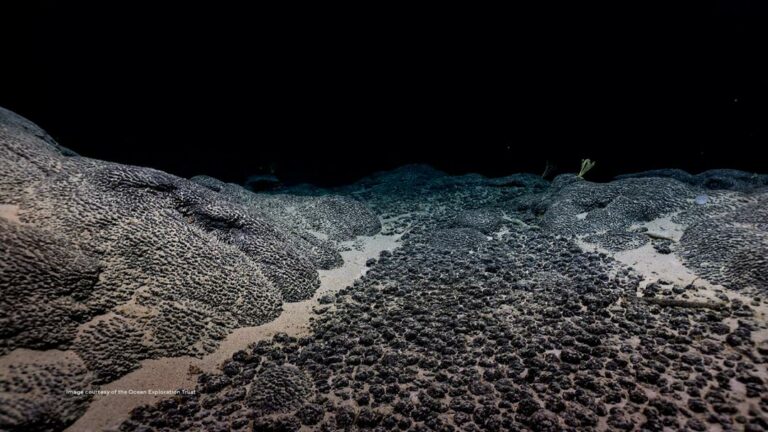
The report’s conclusions are unequivocal regarding the extreme fragility of these environments. The deep seabed harbors a largely unknown biodiversity and plays a crucial role in the oxygen cycle as well as carbon storage. Mineral extraction would cause direct destruction of habitats and generate vast sediment plumes capable of affecting marine life over hundreds of square kilometers. The scientific community emphasizes that these disturbances could persist for centuries, particularly because the growth of polymetallic nodules is measured in millions of years.

A Lack of Economic and Social Legitimacy
The economic case for this extractive industry has yet to be proven. Companies often present this exploitation as a necessity for the energy transition, but no economic profitability has yet been formally certified. Deep-sea mining also lacks social legitimacy, as indigenous peoples and local communities have not been sufficiently consulted.
A Growing Political Impact to Preserve the Ocean
Actively supported by the KRESK 4 OCEANS endowment fund, this initiative has resulted in the publication of two major deliverables made available to policymakers and the public: the scientific proclamation and an educational question-and-answer booklet. This international mobilization has already produced tangible effects on the geopolitical stage. By mid-June 2025, thirty-seven states had officially declared themselves in favor of a pause, a moratorium, or a total ban on deep-sea mining.